
Financial Compilation Report in Miami, FL: CPA Cost Guide
Business owners in Miami, FL often need professionally presented financial statements when communicating with lenders, investors, business partners, or management teams. However, understanding the difference between ordinary bookkeeping reports and a Financial Compilation Report is essential before requesting CPA services.
A Financial Compilation Report helps businesses present management-provided financial information through a professional compilation engagement. Unlike an audit or review, a compilation does not provide assurance on the financial statements.
Whether you operate an LLC, corporation, startup, or established company in Miami, FL or anywhere across all 50 states, understanding CPA compilation costs, reporting requirements, and documentation can help you select the appropriate financial reporting service.
In this guide, Minimise Tax explains how the compilation process works, what affects CPA fees, and what businesses should prepare before requesting a report.
Financial Compilation Report Services for Miami, FL Businesses
Businesses in Miami, FL may need compiled financial statements for internal financial reporting, business planning, financing discussions, or third-party documentation requests.
A CPA compilation engagement can help present financial information using an appropriate accounting framework without providing audit or review assurance.
Minimise Tax assists businesses seeking professional CPA and financial reporting services in Miami, FL and nationwide.
Businesses that may consider compilation services include:
LLCs and small businesses preparing financial statements for management.
Real estate businesses organizing financial information for reporting purposes.
Professional service firms requiring structured financial statements.
E-commerce businesses presenting revenue and expense information.
Corporations and growing enterprises preparing periodic financial reports.
Before requesting a Financial Compilation Report, confirm whether the intended recipient accepts compiled financial statements or requires a review or audit.
Can Businesses Outside Miami, FL Request a Financial Compilation Report?
Yes. Financial compilation engagements can often be coordinated remotely using electronic accounting records, secure document sharing, and online communication.
Minimise Tax supports clients seeking CPA and accounting services in Miami, FL and across all 50 states, subject to applicable licensing and professional requirements.
Businesses can discuss their reporting period, accounting records, financial statement requirements, and expected engagement scope before proceeding.
A Financial Compilation Report is not limited to businesses operating in Miami. Companies in other states may also request compilation services when professionally presented financial statements are appropriate for their needs.
How a CPA Letter May Reduce Mortgage Documentation Delays
A well-prepared CPA Income Verification Letter can help address a specific documentation question before it results in repeated requests.
For example, a lender reviewing a consultant’s application might need confirmation that the applicant has operated an independent business for a particular period.
If the accountant has suitable records, a focused letter may help establish that fact.
The main advantage is not bypassing underwriting. It is giving the lender relevant, properly supported information in a usable format.
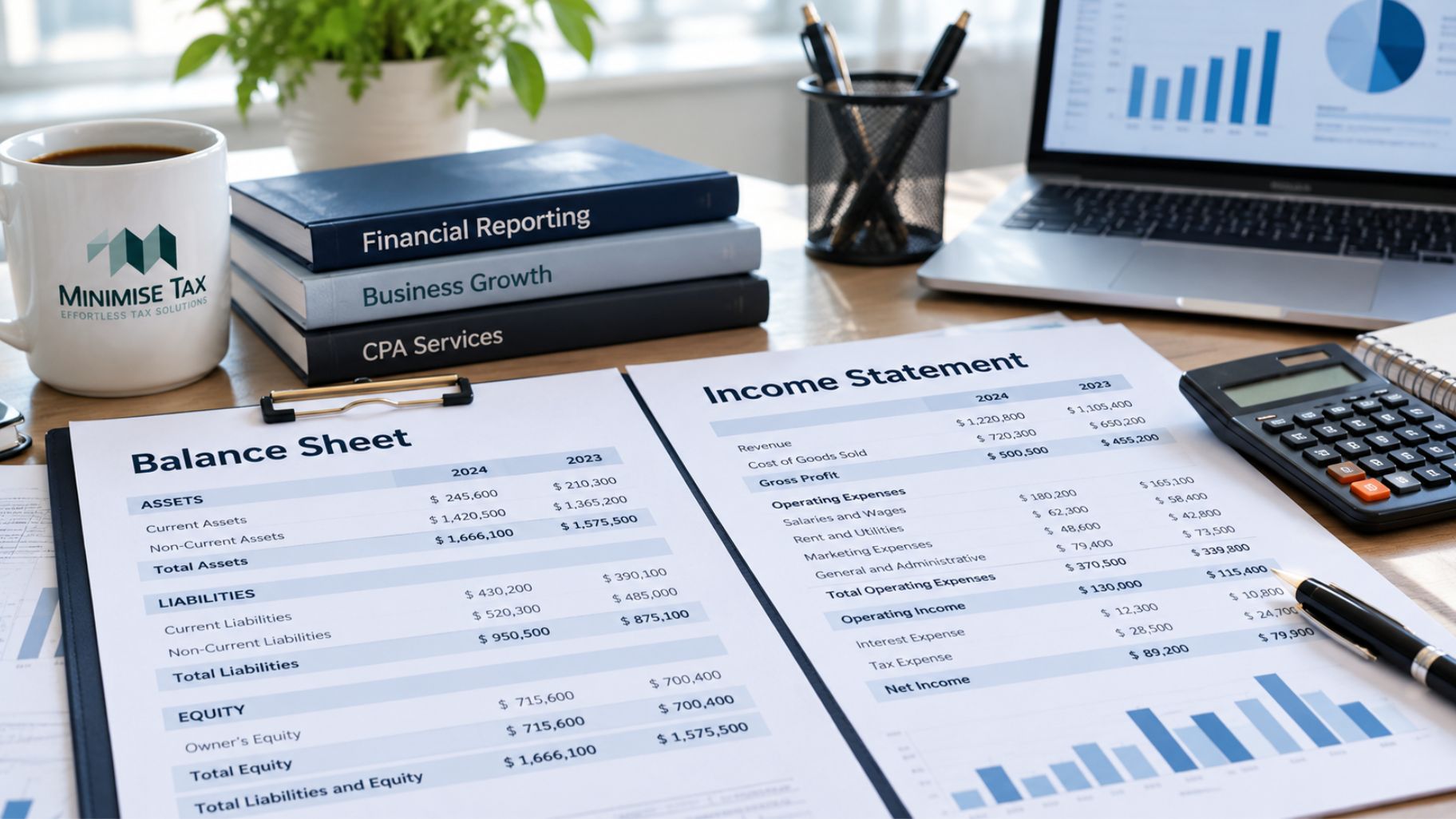
How Much Does a Financial Compilation Report Cost?
There is no universal CPA compilation fee. Pricing depends on the business’s financial records, reporting requirements, accounting complexity, and the professional work needed.
Important cost factors include:
Number of business entities and accounts.
Condition and completeness of bookkeeping records.
Reporting periods requested.
Applicable accounting framework.
Number of required statements and disclosures.
Accounting adjustments needed before compilation.
Reporting deadlines and engagement scope.
A business with reconciled accounts and organized financial statements may require less preparation than a company with incomplete transactions or multiple reporting entities.
Practical recommendation: Request a written scope and fee estimate before proceeding. Confirm whether bookkeeping cleanup, adjustments, additional periods, and financial statement disclosures are included.
Need a Financial Compilation Report? Explore fee factors, required records, CPA reporting standards and smart questions to ask before starting every engagement.
The CPA Compilation Process, Reporting Requirements and Business Value
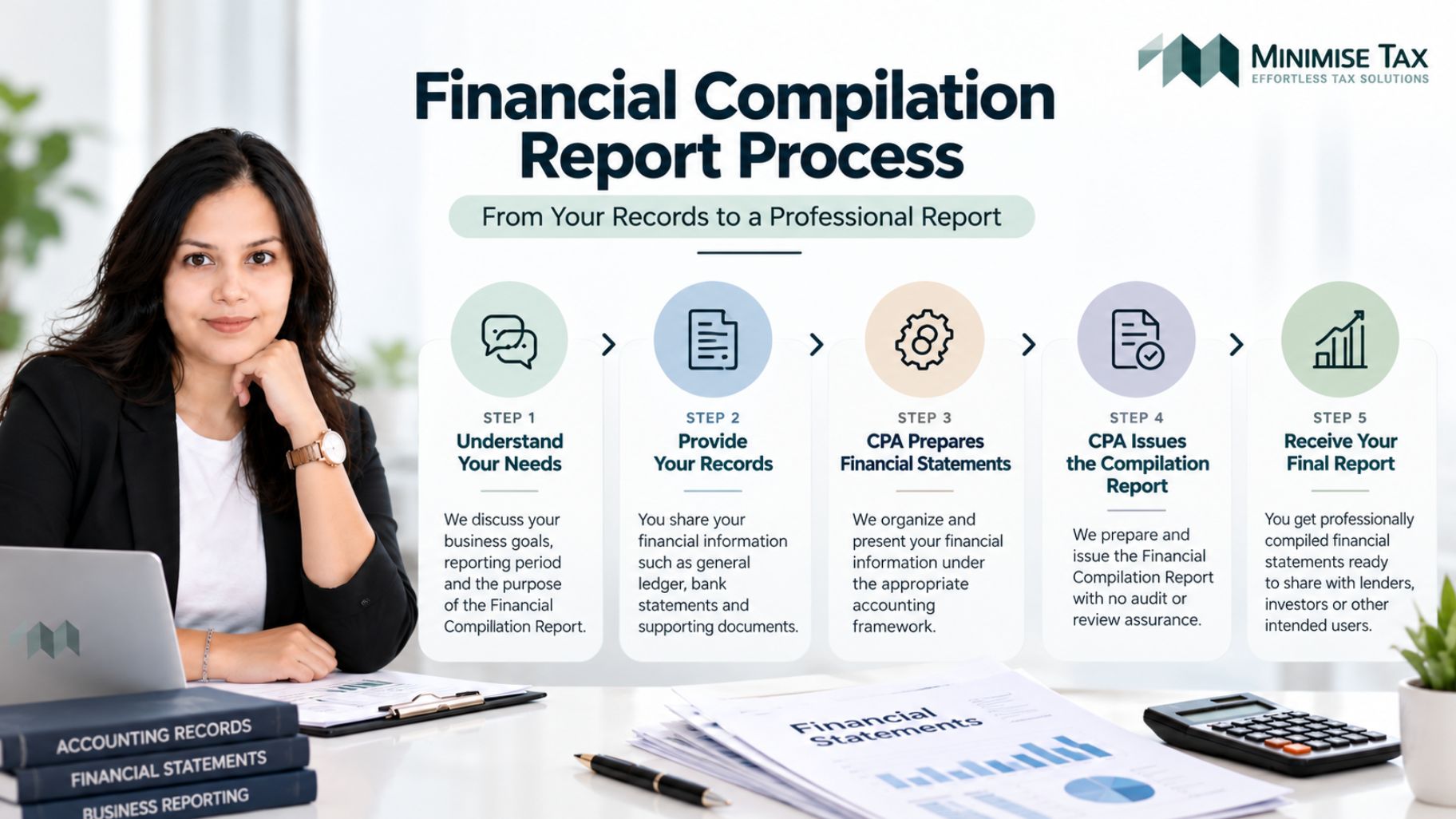
Step 1: Clarify the Purpose of the Report
The process begins by identifying why the financial statements are needed.
A business may require them for internal reporting, a financing discussion, ownership planning, or another third-party request.
The CPA should understand the reporting period, intended use, accounting framework, and any recipient-specific requirements.
This initial conversation helps avoid ordering a report that does not satisfy the actual request.
Step 2: Prepare Your Financial Documents
Accurate source information makes the compilation process more efficient.
Common documents include:
General ledger and trial balance.
Bank and credit card statements.
Accounts receivable and payable schedules.
Loan balances and supporting statements.
Fixed asset and depreciation records.
Inventory information, when applicable.
Prior-period financial statements.
Relevant accounting policies and adjustments.
Not every engagement requires every document. The CPA identifies what is appropriate for the circumstances.
Important: Providing supporting records does not mean the CPA will audit or independently verify them during a compilation.
Step 3: CPA Reviews the Engagement Requirements
A CPA compilation involves professional responsibilities even though it provides no assurance.
The accountant obtains an understanding of the business and the applicable financial reporting framework sufficient to perform the engagement.
The CPA also establishes the engagement terms, including management’s responsibilities and the nature of the compilation service.
Unlike an audit, a compilation does not ordinarily involve confirmation of balances, transaction testing, or obtaining audit evidence.
If the accountant becomes aware that supplied information is incomplete, inaccurate, or otherwise unsatisfactory, appropriate follow-up may be necessary.
Step 4: Financial Statements Are Prepared and Presented
The accountant uses management’s financial information to prepare and present statements under the selected reporting framework.
Depending on the engagement, this could involve U.S. GAAP, a tax basis, a cash basis, or another appropriate framework.
The reporting basis matters because it influences financial statement presentation and disclosure requirements.
Management remains responsible for the accuracy and completeness of the information and the financial statements.
Where permitted, substantially all disclosures may be omitted if the required conditions are satisfied and the omission is properly communicated.
Step 5: The CPA Issues the Compilation Report
Once the compilation procedures are completed, the accountant issues the report accompanying the financial statements.
The report identifies the statements and explains that the engagement was performed under the applicable compilation standards.
It also makes clear that the CPA provides no opinion, conclusion, or assurance.
If the accountant is not independent, the compilation report must disclose the lack of independence.
Businesses should review the final documents to confirm that the requested periods, entity names, and reporting framework match the intended purpose.
What Makes a Compilation Useful for Business Owners?
A compilation can help businesses organize financial information into a more consistent presentation.
Potential benefits include:
Financial visibility: Understand reported assets, liabilities, revenue, and expenses.
Consistent presentation: Use financial statements prepared under an identified framework.
Management discussions: Review financial results in a structured format.
Third-party communication: Provide professionally compiled statements when accepted.
Reporting preparation: Identify areas where accounting records may require additional attention.
These benefits should not be confused with verification or assurance.
A compilation does not certify profitability, confirm available cash, guarantee financing approval, or establish that every accounting balance is correct.
How to Avoid Delays and Unnecessary CPA Fees
Business owners can prepare for a compilation by reconciling accounts, resolving uncategorized transactions, and identifying missing financial information before the engagement begins.
Confirm the financial reporting period and the recipient’s requirements early.
Also, distinguish bookkeeping cleanup from compilation services. Significant bookkeeping corrections may require separate work and additional fees.
Ask whether the quoted fee covers financial statement preparation, necessary disclosures, the accountant’s report, and requested reporting periods.
A clearly defined scope supports more predictable communication and fewer last-minute changes.
How to Avoid Delays and Unnecessary CPA Fees
Business owners can prepare for a compilation by reconciling accounts, resolving uncategorized transactions, and identifying missing financial information before the engagement begins.
Confirm the financial reporting period and the recipient’s requirements early.
Also, distinguish bookkeeping cleanup from compilation services. Significant bookkeeping corrections may require separate work and additional fees.
Ask whether the quoted fee covers financial statement preparation, necessary disclosures, the accountant’s report, and requested reporting periods.
A clearly defined scope supports more predictable communication and fewer last-minute changes.
When Should You Contact a CPA?
Consider discussing compilation services when your business needs professionally presented financial statements but the intended recipient does not require audit or review assurance.
Early consultation is particularly useful when reporting deadlines are approaching, business accounts are complex, or the required accounting framework is unclear.
A CPA can explain the engagement limitations and determine whether a compilation is appropriate.
The best starting point is not simply requesting the least expensive report. It is identifying the correct financial reporting service for the intended use.
Financial Compilation Report FAQs for Miami, FL Businesses
Yes. A newly established LLC may request compiled financial statements for an available reporting period. The CPA will need appropriate financial information and a clearly identified reporting framework.
Yes. A compilation may address financial statements for a business operating multiple locations, depending on its accounting structure and engagement scope. Businesses in Miami, FL & Across USA can discuss their reporting requirements with a CPA.
No. Investors may require additional schedules, independent verification, reviewed statements, or audited financial statements. Confirm their documentation requirements before commissioning the engagement.
Yes. A cash-basis framework may be appropriate for certain compilation engagements. The CPA should determine the applicable presentation and reporting requirements.
Not automatically. Compiled financial statements are generally prepared for the business and its intended users. Disclosure depends on applicable requirements and the business's decisions.
Yes. Accounting software may provide useful source reports. However, the information must still be appropriate for the compilation engagement and selected reporting framework.
Yes. Compilation engagements can address quarterly or other reporting periods. Businesses in Miami, FL & Across USA should confirm which periods their financial statement users need.
No. A compilation provides no assurance about financial condition, solvency, profitability, or future performance.
Yes, depending on the requested presentation, applicable framework, and available records. Separate, combined, or consolidated statements may involve different accounting considerations.
No. Independence is not required for a compilation engagement, but a lack of independence must be disclosed in the accountant's compilation report.
Yes. Financial records and engagement communications can often be handled electronically. Clients in Miami, FL & Across USA should confirm applicable CPA licensing and engagement requirements.
Yes. Management can raise identified errors or changes. The CPA must evaluate whether revisions are appropriate and whether a revised report is necessary.
Need a Financial Compilation Report in Miami, FL? Contact Minimise Tax
Conclusion
A Financial Compilation Report helps businesses present financial information professionally when audit or review assurance is not required.
Whether your company operates in Miami, FL or elsewhere across all 50 states, understanding the compilation process, CPA responsibilities, required documents, and pricing factors can help you make an informed decision.
Minimise Tax provides professional CPA and financial reporting services to businesses seeking clear financial documentation and appropriate accounting support.
Looking for Financial Compilation Report services in Miami, FL?
Visit Minimise Tax to discuss your financial reporting requirements and request information about CPA compilation services.