
GAAP Financial Statements for Growing American Business Owners
Your business may be profitable, but can your financial statements demonstrate that profitability to a bank, investor, or potential buyer?
Running a successful business involves more than generating revenue and managing expenses. It also requires presenting financial information accurately, consistently, and transparently.
GAAP Financial Statements help business owners communicate their financial position using recognized accounting standards. These statements can support financing applications, investment opportunities, business acquisitions, and financial decision-making.
However, many business owners are uncertain about whether GAAP reporting is mandatory, which documents are necessary, and when professional CPA assistance is appropriate.
This guide explains US GAAP Financial Statements, essential financial statements, reporting responsibilities, and practical preparation strategies for businesses across all 50 states.
Understanding GAAP Financial Statements and US Business Requirements
GAAP Financial Statements are financial reports prepared according to Generally Accepted Accounting Principles in the United States. These principles establish how businesses recognize, measure, present and disclose financial transactions.
The Financial Accounting Standards Board (FASB) maintains the authoritative accounting standards for nongovernmental entities through its Accounting Standards Codification.
fasb.org+1
GAAP helps businesses produce financial information that stakeholders can understand and compare.
Rather than simply recording money received and payments made, GAAP reporting considers economic activities, outstanding obligations, earned revenue and applicable accounting estimates.
For example, a business may receive an advance payment before delivering a product. Under applicable GAAP revenue recognition principles, receiving cash does not necessarily mean the business can immediately recognize the entire amount as revenue.
This distinction becomes particularly important when financial statements are presented to external stakeholders.
Which US Businesses Need GAAP Financial Statements?
Not every business operating in the United States must prepare GAAP-compliant financial statements. Reporting obligations depend on regulatory requirements, contractual agreements and the intended users of financial information.
Domestic public companies generally must follow US GAAP when preparing financial statements for SEC reporting. Most privately owned businesses do not face a universal federal requirement to use GAAP.
However, GAAP reporting may be required or requested by:
Commercial lenders and financial institutions
Private equity firms and investors
Business acquisition partners
Government or regulatory authorities
Corporate shareholders
Franchise agreements
Commercial loan agreements
Certain grant and funding programs
Small businesses, LLCs, partnerships and privately held corporations should review their agreements before selecting an accounting framework.
For instance, a privately owned manufacturing company seeking commercial financing may discover that its lender requires reviewed GAAP Financial Statements instead of internally prepared accounting reports.
Understanding these expectations early can prevent unnecessary reporting delays.
Essential Components of GAAP Financial Statements
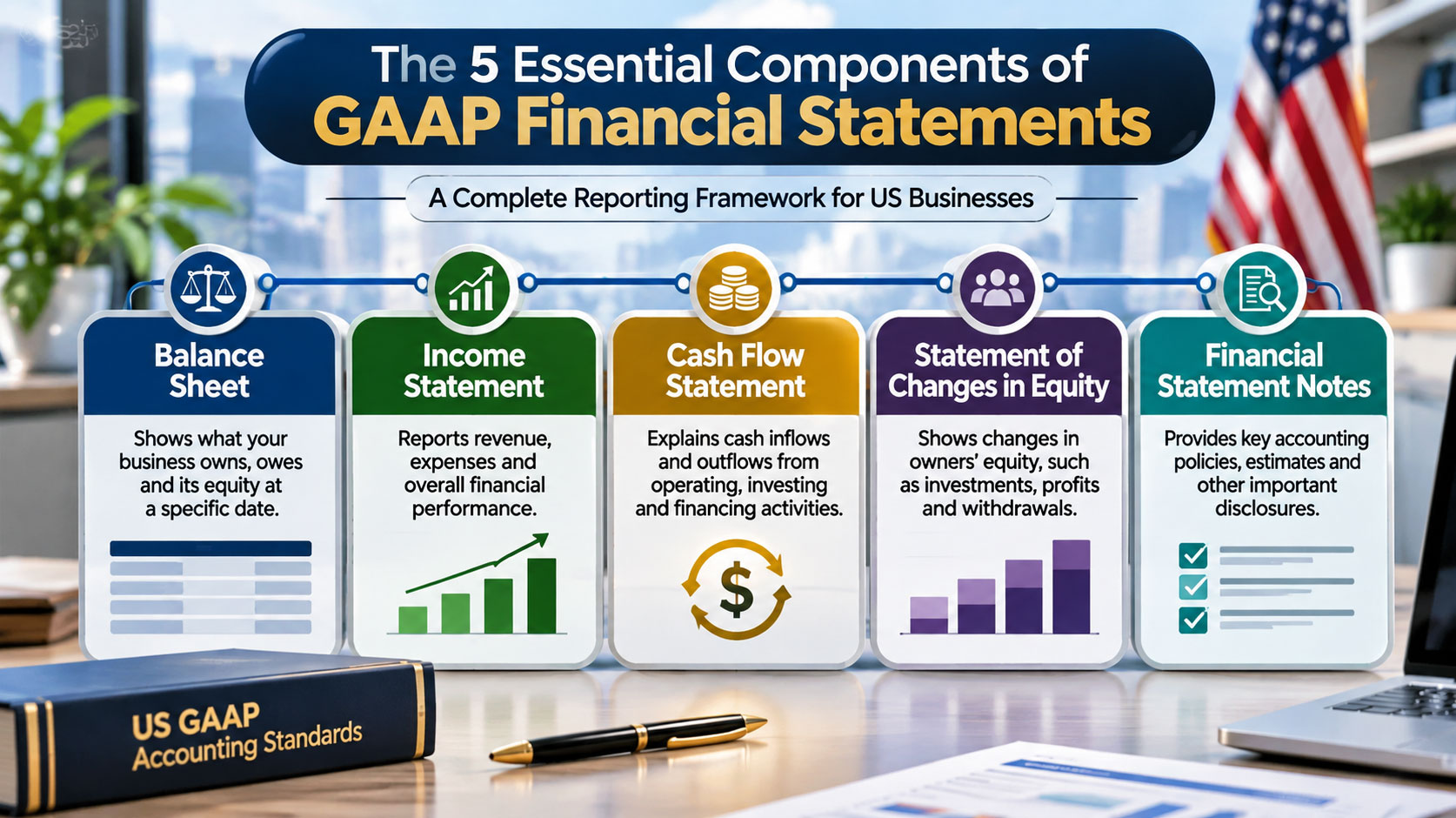
A complete set of GAAP financial statements for a typical commercial business generally includes the following components.
Financial Statement | Primary Purpose |
|---|---|
Balance Sheet | Presents assets, liabilities and equity at a specific date. |
Income Statement | Reports revenue, expenses and financial performance. |
Cash Flow Statement | Explains operating, investing and financing cash flows. |
Statement of Changes in Equity | Shows movements in ownership equity. |
Financial Statement Notes | Explains accounting policies, estimates and relevant disclosures. |
Each component contributes to a more complete understanding of the business.
The income statement may show a profit, while the cash flow statement reveals difficulties collecting customer payments. Similarly, the balance sheet may identify increasing debt obligations that are not immediately apparent from revenue figures.
The real value of GAAP Financial Statements comes from understanding how these reports work together.
How to Prepare GAAP Financial Statements for Business Compliance
Preparing GAAP-compliant reports requires more than exporting financial information from accounting software.
Business owners must evaluate whether their accounting records reflect the underlying economic activities and comply with applicable recognition, measurement and disclosure requirements.
A structured preparation process can improve reporting accuracy and help identify accounting issues before financial statements are distributed.
A Practical GAAP Financial Reporting Checklist
Businesses can establish a more reliable reporting process by following these steps:
1. Organize financial records
Collect bank statements, invoices, expense records, payroll information, loan agreements and previous financial reports.
2. Reconcile accounting balances
Compare recorded transactions with bank accounts, credit cards, receivables and outstanding liabilities.
3. Apply appropriate accrual accounting
Recognize revenue and expenses in the appropriate reporting periods rather than relying exclusively on cash movements.
4. Evaluate GAAP adjustments
Review depreciation, inventory valuation, leases, deferred revenue, credit losses and other applicable accounting requirements.
5. Prepare financial statement disclosures
Document significant accounting policies, commitments, estimates, contingencies and relevant business information.
6. Evaluate reporting requirements
Determine whether the intended recipient requires prepared, compiled, reviewed or audited financial statements.
7. Establish a consistent reporting schedule
Maintain monthly or quarterly closing procedures to reduce year-end accounting adjustments and improve financial visibility.
These steps can help businesses develop a dependable financial reporting system instead of reconstructing financial records whenever a lender requests documentation.
Minimise Tax provides financial statement services across major US cities, including New York, Miami, Chicago, Houston, Dallas, Los Angeles, Atlanta and other locations nationwide.
GAAP Financial Statements vs Tax Basis Financial Statements
Business owners frequently assume their tax returns and financial statements should report identical profits. However, financial reporting standards and tax regulations serve different purposes.
GAAP reporting focuses on presenting economic performance and financial position. Tax basis accounting generally follows applicable income tax accounting rules.
Comparison | GAAP Financial Statements | Tax Basis Statements |
|---|---|---|
Primary purpose | Financial reporting | Income tax basis reporting |
Accounting framework | FASB standards | Applicable tax accounting rules |
Revenue recognition | Applicable GAAP principles | Tax accounting requirements |
Depreciation | Financial reporting estimates | Applicable tax depreciation rules |
Disclosures | Required GAAP disclosures | Relevant tax basis disclosures |
Common users | Investors, lenders and management | Owners and tax professionals |
For example, accelerated tax depreciation may create a different expense amount from depreciation recorded for financial reporting purposes.
These differences do not automatically indicate accounting errors. Instead, businesses should understand and document the reasons behind them.
Choosing the Right CPA Financial Statement Service
GAAP compliance and CPA assurance are separate considerations.
A business can prepare GAAP-compliant financial statements without obtaining an audit. However, external stakeholders may require a specific CPA engagement.
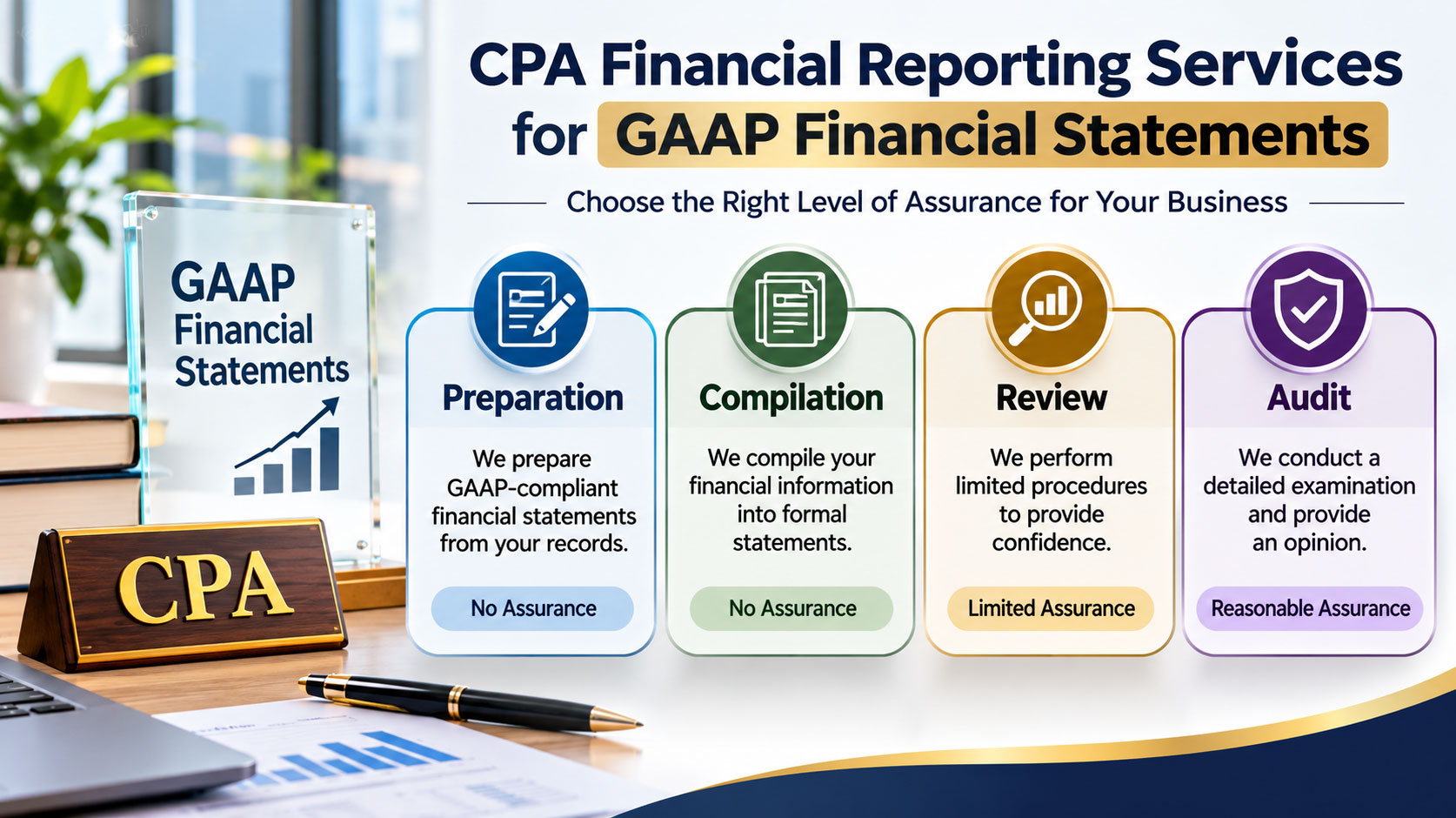
CPA Service | Assurance Level |
|---|---|
Financial Statement Preparation | No assurance |
Financial Statement Compilation | No assurance |
Financial Statement Review | Limited assurance |
Financial Statement Audit | Reasonable assurance |
A compilation assists management in presenting financial information. A review generally involves inquiries and analytical procedures, while an audit involves more extensive procedures and an auditor’s opinion.
Before engaging a CPA, ask your lender or investor which reporting framework and engagement level they require.
Choosing the appropriate service can help avoid unnecessary costs and repeated financial statement preparation.
What Makes GAAP Reporting Valuable for Growing Businesses?
GAAP reporting can help business owners identify financial risks that ordinary bookkeeping reports may overlook.
For example, recognizing outstanding liabilities can reveal future payment obligations. Evaluating accounts receivable can also highlight collection problems before they become significant cash flow challenges.
Consistent financial reporting may support:
Business expansion and commercial financing
Investor communication and financial transparency
Budgeting and cash flow forecasting
Business valuation and acquisition discussions
Financial performance comparisons
Identification of accounting inconsistencies
Companies operating in multiple states can generally use the same US GAAP framework while separately addressing applicable state tax and regulatory responsibilities.
For businesses preparing for growth, investing in reliable accounting processes before external reporting becomes necessary can make future financial decisions more informed.
How to Avoid Delays and Unnecessary CPA Fees
Business owners can prepare for a compilation by reconciling accounts, resolving uncategorized transactions, and identifying missing financial information before the engagement begins.
Confirm the financial reporting period and the recipient’s requirements early.
Also, distinguish bookkeeping cleanup from compilation services. Significant bookkeeping corrections may require separate work and additional fees.
Ask whether the quoted fee covers financial statement preparation, necessary disclosures, the accountant’s report, and requested reporting periods.
A clearly defined scope supports more predictable communication and fewer last-minute changes.
When Should You Contact a CPA?
Consider discussing compilation services when your business needs professionally presented financial statements but the intended recipient does not require audit or review assurance.
Early consultation is particularly useful when reporting deadlines are approaching, business accounts are complex, or the required accounting framework is unclear.
A CPA can explain the engagement limitations and determine whether a compilation is appropriate.
The best starting point is not simply requesting the least expensive report. It is identifying the correct financial reporting service for the intended use.
GAAP Financial Statements FAQs for Business Owners Across the USA
Yes. Startups can adopt GAAP accounting standards from their first reporting period. Establishing appropriate accounting policies early can simplify future financial reporting and investor discussions.
Yes. An LLC can transition to GAAP by evaluating receivables, liabilities, inventory, revenue recognition and other necessary adjustments. Professional assistance can simplify the conversion process.
Costs depend on transaction volume, accounting complexity, record quality and engagement requirements. Businesses should obtain a customized quote based on their specific financial reporting needs.
Yes. Minimise Tax provides financial reporting and CPA services across all 50 states, allowing businesses to coordinate documentation and reporting requirements remotely.
QuickBooks provides useful financial reports, but its reports are not automatically GAAP-compliant. Accounting adjustments, appropriate classifications and additional disclosures may be necessary.
Preparation time depends on the completeness of accounting records, business complexity and reporting period. Organized records generally help reduce processing delays.
Yes. GAAP reporting can support financial due diligence by presenting business performance, assets and liabilities consistently. Buyers may request additional verification depending on the transaction.
Yes. Foreign-owned US companies can prepare statements under US GAAP while separately addressing international reporting requirements, ownership structures and applicable tax obligations.
Minimise Tax provides financial statement services across major US cities, including New York, Miami, Chicago, Houston, Dallas, Los Angeles, Atlanta and other locations nationwide.
Not necessarily. Asset measurement depends on the applicable accounting standards. Some assets use historical cost, while others may require fair value measurement or impairment adjustments.
Advance payments may initially be recognized as contract liabilities. Revenue is subsequently recognized when or as the relevant performance obligations are satisfied.
Reliable statements can support valuation analysis by providing consistent financial information. However, business valuation also depends on market conditions, growth prospects, risk and other factors.
Construction businesses apply relevant GAAP standards, including revenue recognition requirements for contracts. Project duration, contract terms and performance obligations affect the accounting treatment.
Yes. E-commerce businesses can use GAAP reporting to improve the accounting treatment of inventory, customer returns, revenue, payment processing fees and outstanding obligations.
A CPA can assist in evaluating financial reporting errors and determining appropriate corrections. Material errors may require adjustments or restatement of previously issued financial information.
Requirements depend on the transaction agreement and buyer expectations. Franchise buyers may request GAAP-based reports to assess profitability, financial obligations and business performance.
Generally, GAAP reporting is based on the reporting entity rather than individual states. Separate reporting may nevertheless be required under specific contracts or regulatory arrangements.
Yes. Minimise Tax offers CPA financial reporting support across all 50 US states, serving business owners who require professional accounting and financial statement services.
Reporting frequency depends on business requirements. Monthly, quarterly or annual preparation may be appropriate based on management needs, financing agreements and regulatory obligations.
No. GAAP-compliant reporting can support financial transparency, but loan approval depends on lender requirements, creditworthiness, collateral, cash flow and other eligibility factors.
Build Financial Confidence With Professional GAAP Reporting
Conclusion
Accurate GAAP Financial Statements can help businesses understand their financial position, address reporting obligations and communicate financial information more effectively.
Whether you operate a startup, LLC, partnership, corporation or established enterprise, professional accounting assistance can help you navigate complex reporting requirements.
Minimise Tax provides nationwide CPA and financial reporting services across all 50 US states, helping businesses address their financial statement preparation and reporting needs.
Need GAAP-compliant financial statements for business financing, investor reporting or financial compliance?
Contact Minimise Tax today for professional CPA financial reporting assistance.