
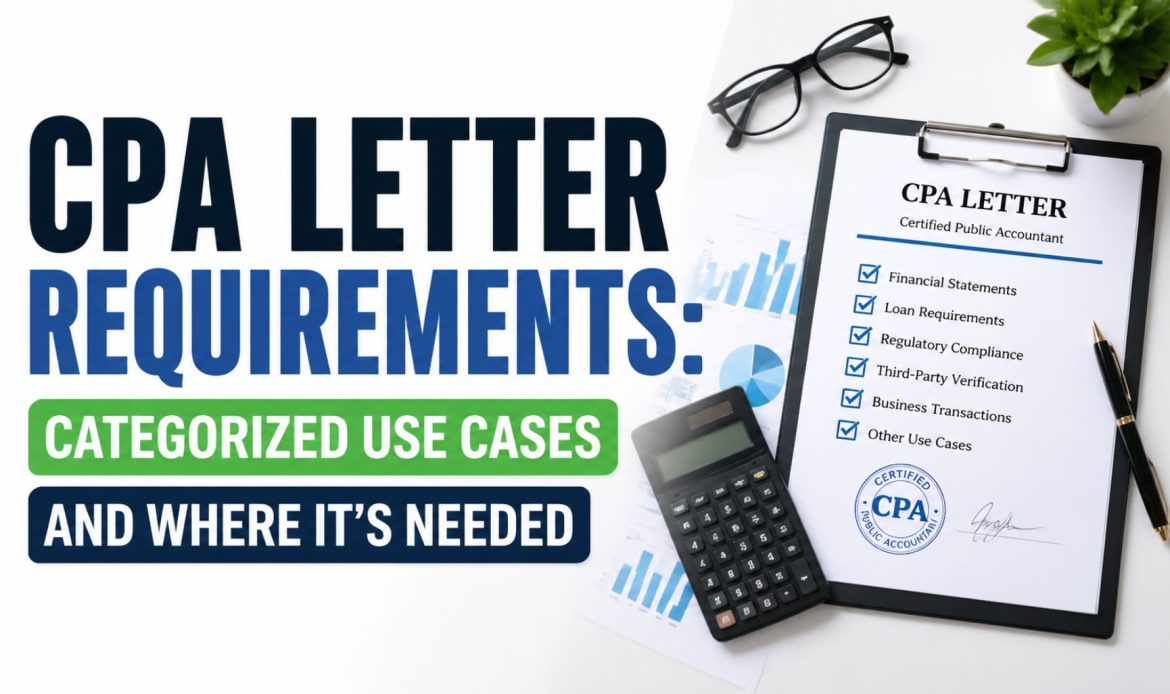
CPA Letter Requirements: Categorized Use Cases and Where It’s Needed

Nisha
CPA | Founder of Minimise Tax
As the financial world becomes more detailed and complex each day, the demand for accurate and trustworthy information increases. A CPA letter, issued by a Certified Public Accountant, is a document that is extremely valued and trusted, since it brings transparency to the customers and clarity on financial reporting. The letter acts as an authoritative affirmation of an individual’s or business’s financial details, providing assurance to third parties relying on the information presented.
It is applied in different contexts where financial disclosure and precision are essential. It may be a Mortgage request, an IRS audit, a business loan, an application for a visa, or a court hearing, all of which need financial transparency and precision.
The individual requirements of a CPA comfort letter depend on its purpose and the requesting organization. Let us look at some of the most important use cases for a CPA letter and what it contains in general.
What is a CPA Letter?
A CPA letter, also termed as a CPA verification letter, or more commonly referred to as a CPA comfort letter, is a signed document from a Licensed Certified Public Accountant. This information in a letter from the CPA helps to:
- Verifies certain facts about money and finances
- Confirms compliance with tax or accounting rules
- Offers professional opinion on financial matters
A few examples of the most common uses of a CPA letter are proof of income, verification of financial stability, assistance in applying for loans and visas, and compliance for legal purposes.
Categorized Use Cases and Where CPA Letters Are Required
CPA letters can be used to verify financial status, validate income, or guarantee tax and legal compliance, depending on the circumstances. The main situations where CPA letters are usually needed are listed below,
1. Financial Verification and Stability
- Mortgage Applications: Lenders frequently ask for a CPA Letter for Mortgage to confirm proof of income documents for self-employed or business individuals to explain unusual deposits, or to verify large deposits.
- Apartment Rentals: Landlords request for a CPA Letter for an apartment to verify a tenant’s income, especially if a tenant has irregular or freelance earnings. A letter from the CPA to lenders and third party verifications provides documented assurance to property managers.
- Business Loan Applications: When requesting a letter from CPA for business loan is usually required by lenders to:
- Evaluate the financial condition of the business
- Authorize financial statements
- Describe certain accounting entries
2. Tax Compliance and Audits
- IRS Audits: CPA Letter from IRS Audit may confirm tax return details, clarify large deductions, or explain unusual financial activity.
- Business Partnerships or Mergers: CPA letter ensures tax compliance and financial transparency, assuring potential partners that tax filings are current and accurate.
- Grant or Funding Applications: Non-profit organizations and businesses frequently require CPA letter to:
- Show tax compliance
- Authenticate proper usage of grant funds
3. Legal Proceedings & Divorce or Child Support Cases
In cases of law such as divorce or child support, a letter from CPA can:
- Accurately determine a party’s income
- Record financial resources for the court
4. Financial Transparency and Accountability
CPA letter in situations like Internal or External Audits can be asked to:
- Certify the financial statements’ accuracy
- Confirm an audit was performed within the appropriate standards
5. E-2 Visa Applications and Other Visas
A CPA letter for a visa (like an E-2 visa, L1 visa, or investor visa) is frequently needed to:
- Confirm the source and amount of investment capital
- Establish the financial viability of a company
Other Use Cases
- Grant Applications : CPA letters may be utilized to showcase financial responsibility and guarantee grant monies will be used accordingly.
- Partnership Agreements: In partnerships, CPA letters assist in confirming the financial condition of each partner and their ability to fulfill obligations.
- Debt Management: A CPA letter may assure the solvency of a person or company, proving they can handle debt responsibly.
General Requirements for a CPA Letter
An appropriate CPA letter should contain:
- Introduction: Stipulates the purpose of the letter, mentions the name of the client, and the extent of the work done by the CPA.
- Scope of Work: Explains the steps the CPA executed or the nature of the financial review performed.
- Financial Verification: Verifies the validity of the information presented on a financial basis, according to the review or analysis carried out by the CPA.
- Professional Opinion: Provides the CPA’s professional opinion about the individual’s or company’s financial situation.
The majority of institutions will demand notarization of the CPA letter, depending on jurisdiction and state law.
Key Considerations
- Varying Specific Requirements: Every organization can ask for some formats or data in a CPA letter based on the use case.
- Professional Responsibility: CPAs owe a responsibility to give correct and objective financial data. These letters entail professional liability.
- Risk Mitigation: Relying parties (banks, courts, immigration officials) utilize CPA letters to assess and reduce financial risk in the decisions they make.
Conclusion
A CPA letter is a crucial document in most financial, legal, and business situations. Knowing the requirements and classified use cases of CPA letters prepares you for the circumstances when financial verification is required. Be sure to work with a licensed CPA to guarantee that your letter is correct and in the correct format.
If you are in need of assistance in getting a CPA letter for your circumstance, speak with a reputable CPA today
FAQs
Anyone who is required to present verified financial records might require a CPA letter. Such groups include:
- Self-employed individuals seeking a mortgage or apartment lease
- Business people seeking loans or grants
- Non-residents seeking a U.S. visa
- People engaged in legal or financial cases
As a rule, CPA letters expire after 30 to 90 days, depending on the institution's needs. More extended validity is accepted by some organizations for audit or tax purposes.
No. A CPA letter should be written and signed by CPAs who are licensed. Financial advisors, bookkeepers, or other professionals can't send out CPA letters unless they are licensed CPAs. Always ensure the individual preparing your letter is an active CPA licensee.
The turnaround time varies depending on the CPA’s schedule and the complexity of your request. Simple letters can be released within 1–3 business days, but more comprehensive or compliance-related letters may take up to a week or more. Having complete documentation available initially can accelerate the process.
No. A CPA letter is a summary verification or professional opinion from available information, not an entire audit. Audited financial statements have a much more thorough inspection and adhere strictly to audit standards. CPA letters are usually faster and utilized for verification purposes.
Yes. A CPA can refuse to issue a letter if they are not comfortable verifying the information or if the request exceeds their professional scope, or if the necessary documentation is lacking. CPAs are bound to follow professional ethics and can reject any request they consider inappropriate or risky.
Categorized Use Cases and Where CPA Letters Are Required
Conclusion
A CPA letter is a crucial document in most financial, legal, and business situations. Knowing the requirements and classified use cases of CPA letters prepares you for the circumstances when financial verification is required. Be sure to work with a licensed CPA to guarantee that your letter is correct and in the correct format.